E-mail seo@sino-purification.com

Time:2026-01-22 13:27:57 Reading volume:
Insulating oil filtration equipment is essential for maintaining the dielectric strength, thermal stability, and service life of transformers and other high-voltage electrical equipment. Effective filtration removes moisture, dissolved gases, solid particles, and aging byproducts, reducing insulation failure risk and unplanned outages.
Proper equipment selection depends on contamination type, treatment objectives, processing capacity, and site conditions.
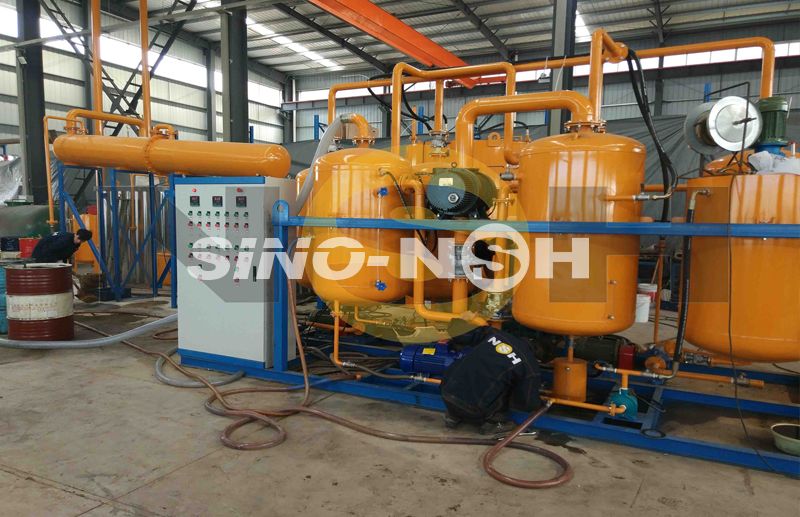
Insulating oil filtration removes water, gases, particulates, and chemical degradation products from transformer oil to maintain compliance with standards such as IEC 60422 and GB/T 7595. This process improves breakdown voltage (BDV), slows insulation aging, and extends transformer lifespan.
Principle
Oil is heated and treated under vacuum to remove moisture, dissolved gases, and fine particles through evaporation and multi-stage filtration.
Key Features
Dehydration and degassing to ≤ 5 ppm
Precision filtration to 1–5 μm
Significant improvement in BDV
Applications
New oil filling and commissioning
Online/offline transformer oil treatment
Preventive maintenance
Best for: Comprehensive purification (water, gas, particles)
Principle
Pressurized oil passes through filter paper or cloth to remove solid particles and free water.
Key Features
Low cost and simple operation
Effective for coarse filtration
Limited removal of dissolved moisture and gases
Requires frequent filter media replacement
Applications
Pre-treatment of heavily contaminated oil
Sites with limited infrastructure
Best for: Coarse filtration and pre-treatment

Principle
Uses centrifugal force to separate oil, water, and solids by density.
Key Features
No consumables required
Effective for free water and large particles
Ineffective for dissolved moisture and gases
Applications
Mechanical pre-treatment of oil with heavy contamination
Best for: Pre-separation before fine purification
Principle
Adsorbents remove polar contaminants, including water, acids, and oxidation byproducts.
Key Features
Reduces acid value (TAN) and aging products
Often combined with vacuum purifiers
Applications
Regeneration of aged transformer oil
Best for: Deep oil regeneration
| Factor | Selection Guidance |
|---|---|
| Contamination Type | Water & gas → Vacuum purifier Particles → Plate or centrifugal filter Aged oil → Adsorption system |
| Treatment Objective | Impurity removal → Plate/centrifugal Full purification → Vacuum purifier Regeneration → Vacuum + adsorption |
| Processing Capacity | Large transformers → ≥ 6000 L/hSmall use → Portable units |
| Site Conditions | Power supply, space, lifting access, and ambient temperature |
| Oil Properties | Heating temperature must match viscosity and flash point |
| Standards | Must meet IEC 60422, GB/T 7595, or equivalent |
Routine Maintenance: Plate & frame filter + vacuum oil purifier
Severe Contamination: High-efficiency vacuum oil purifier
Oil Aging: Vacuum purifier + adsorption unit
Emergency or Mobile Use: Integrated mobile vacuum filtration system
Conclusion
For most transformer applications, vacuum insulating oil purifiers—often combined with adsorption systems—provide the most reliable and standards-compliant solution. Selecting the right filtration equipment based on oil condition and operating requirements ensures long-term electrical safety, reduced maintenance costs, and extended equipment life.
Explosion-Proof Oil Purifier Selection Guide: Which Working Conditions Require One?
How to Prevent Rapid Lubricating Oil Degradation in Steel Mills
Can an Oil Purifier Remove Acid? Understanding the Limits of Oil Regeneration
Chemical Industry Oil Purification: How to Choose the Right Oil Purifier
Why Is Coalescing Water Removal More Stable Than Vacuum Dehydration?