E-mail seo@sino-purification.com

Time:2026-01-20 13:49:44 Reading volume:
Transformer oil degassing is a critical maintenance process that ensures the safe, reliable, and efficient operation of power transformers. By removing dissolved gases and moisture from insulating oil, vacuum degassing restores dielectric strength, slows insulation aging, and prevents catastrophic electrical failure. For high-voltage transformers, maintaining breakdown voltage (BDV) above 70 kV and gas content below 0.3% is essential—and degassing is the proven method to achieve these thresholds.
This guide covers what transformer oil degassing is, why it matters, how it works, key standards, and frequently asked questions.
Transformer oil degassing is the process of removing dissolved gases (oxygen, nitrogen, hydrogen, carbon dioxide, and hydrocarbons) and air bubbles from insulating oil used in oil-filled power transformers. It is typically performed as part of a vacuum oil purification process, in which degassing, dehydration, and solid-particle filtration work together to restore oil quality.
During normal operation, insulating oil is exposed to high temperatures, electrical stress, oxidation, and aging insulation paper—causing gases and moisture to dissolve into the oil. If not removed, this leads to:
Reduced dielectric strength and increased risk of arcing
Accelerated insulation aging and shortened transformer life
Partial discharge activity and gradual insulation erosion
Unplanned outages and costly equipment failure
Degassing improves oil's ability to withstand electrical stress and directly protects internal insulation materials, ensuring transformer reliability and longevity.
Common gases removed include oxygen (accelerates oxidation), nitrogen (reduces dielectric strength), hydrogen (indicates partial discharge), carbon dioxide (signals paper insulation aging), and hydrocarbons like methane and acetylene (indicators of thermal faults). Removing these gases improves insulation performance and provides cleaner Dissolved Gas Analysis (DGA) data for fault prediction.
Vacuum degassing is the industry standard. Oil is exposed to extremely low pressure in a vacuum chamber, allowing gases and moisture to vaporize and be extracted. It achieves gas content ≤ 0.3% and moisture ≤ 5 ppm, making it suitable for high-voltage and extra-high-voltage transformers.
Thermal degassing uses heating to release gases but is less effective and rarely used for critical applications. Centrifugal degassing separates free gas bubbles from oil and is mainly used in mobile field units, but cannot remove deeply dissolved gases.
Among all methods, vacuum degassing is the preferred solution for modern transformer maintenance.
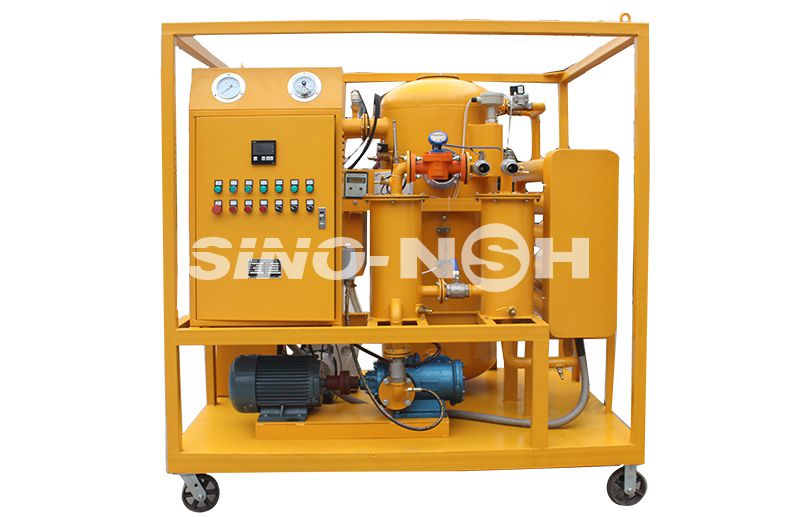
Most degassing operations use a vacuum transformer oil filtration machine, which integrates an oil heating unit (50–65°C) to enhance gas release, a multi-stage vacuum chamber (≤ 50 Pa) for deep degassing, high-precision filters (down to 1 micron) for particle removal, and a vacuum pump system including Roots pumps for continuous operation.
Equipment options include portable oil purifiers for field maintenance and stationary units for substations with higher flow requirements. Modern systems feature PLC controls, real-time monitoring, and automatic shutdown.
After degassing, transformer oil must meet international standards including IEC 60296, ASTM D3487, and IEC 60422. Key quality indicators are gas content ≤ 0.3% by volume, BDV ≥ 70 kV for high-voltage class, moisture content ≤ 5 ppm, and particle filtration below 1 micron. Routine testing of BDV and moisture ensures consistent oil quality.
Transformer oil degassing is one part of a complete purification cycle. Filtration removes solid contaminants and sludge. Dehydration eliminates dissolved and free water. Degassing removes air and fault gases. Together in a vacuum oil filtration system, these stages restore the oil‘s dielectric, physical, and chemical properties.
Frequency depends on load, voltage, and environment. Most transformers benefit from annual or biannual testing, with degassing when BDV falls below 50 kV or moisture exceeds 15–20 ppm.
Yes. Vacuum degassing restores dielectric strength and slows insulation aging, potentially extending transformer life by 10–15 years compared to untreated oil.
Yes. New oil absorbs gases and moisture during handling and transport. Degassing ensures it meets standards before commissioning.
Untreated oil leads to reduced dielectric strength, increased partial discharge, accelerated insulation aging, sludge formation, and ultimately transformer failure.
Degassing removes dissolved gases; dehydration removes moisture. In a vacuum system, both occur simultaneously as low pressure vaporizes and extracts both.
Transformer oil degassing is a cost-effective preventive measure against unexpected outages and costly rewinds. By restoring oil dielectric strength, removing dissolved gases, and reducing moisture content to ≤5 ppm, degassing extends transformer service life, enhances operational reliability, and reduces maintenance costs.
For utilities and industrial plants, SINO-NSH transformer oil filtration machines integrate vacuum degassing, multi-stage dehydration, and high-precision filtration in a single automated system. Built to meet IEC and ASTM standards, these units deliver consistent oil quality—ensuring reliable power transmission for decades.
Explosion-Proof Oil Purifier Selection Guide: Which Working Conditions Require One?
How to Prevent Rapid Lubricating Oil Degradation in Steel Mills
Can an Oil Purifier Remove Acid? Understanding the Limits of Oil Regeneration
Chemical Industry Oil Purification: How to Choose the Right Oil Purifier
Why Is Coalescing Water Removal More Stable Than Vacuum Dehydration?