E-mail seo@sino-purification.com

Time:2026-11-12 15:51:57 Reading volume:
The first step is to confirm the actual power supply available at the installation site.
Common industrial voltage configurations include 220V, 230V, 380V, 400V, 415V and 460V. However, these values are not universal standards for every country or industrial facility.
You should also confirm whether the site uses single-phase or three-phase power. Most industrial oil purification systems use three-phase power to operate their motors, vacuum pumps and other major components.
Simply providing a voltage value is not enough. The manufacturer also needs to know the power supply type, neutral requirements and grounding conditions where applicable.
Power frequency is another important consideration when exporting oil purification equipment.
Industrial power systems generally operate at 50Hz or 60Hz. Although the difference may seem small, it can affect the operating speed of motors and the performance of pumps.
For example, a motor designed for 50Hz operation may run at a different speed when connected to a 60Hz supply. This can influence pump performance and overall equipment operation.
If your project requires a 60Hz oil purifier, ask the manufacturer to confirm the ratings of the motor, vacuum pump and oil pump. The heating system and electrical control components should also be checked.
Some oil purifiers use variable frequency drives (VFDs) to control motor speed. However, having a VFD does not automatically mean that the entire machine supports both 50Hz and 60Hz power supplies. The compatibility of the complete electrical system must still be verified.
For overseas customers, the control panel language is an important part of equipment usability.
If the oil purifier is equipped with a PLC control system and touchscreen HMI, buyers should specify their preferred operating language before production.
English is commonly used for international projects, while Spanish, Russian, Arabic and other languages may be required depending on the installation location.
It is also important to distinguish between touchscreen language and technical documentation. A machine may have an English operating interface while its wiring diagrams or maintenance manuals are supplied in another language.
Before ordering, confirm that the operating menus, alarm messages, parameter settings and user manuals meet the requirements of your local operators and maintenance team.
To avoid repeated communication and configuration errors, prepare the electrical and control requirements during the quotation stage.
The most important information includes:
Voltage: Actual rated voltage at the installation site.
Power Supply: Single-phase or three-phase.
Frequency: 50Hz or 60Hz.
Control System: Manual operation or PLC automatic control.
HMI Language: Required touchscreen language.
Documentation: Preferred language for operation and maintenance manuals.
If you are unsure about the local electrical specifications, you can provide the manufacturer with a photo of the site power supply label or the project's electrical requirements.
The manufacturer can then check whether the selected oil purifier configuration is suitable for the intended installation.
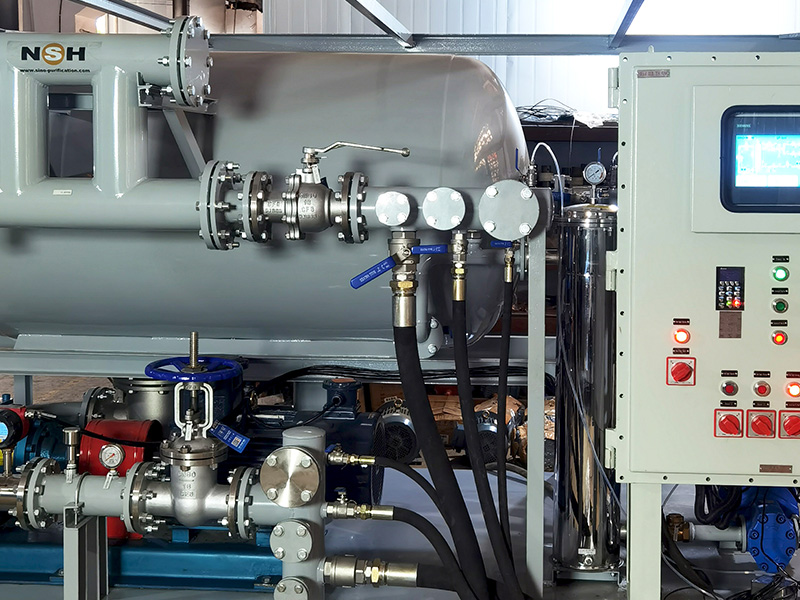
Confirming the requirements before production is only the first step. The actual equipment should also be checked before shipment.
Make sure the voltage and frequency on the equipment nameplate match the agreed specifications. Motor ratings, electrical cabinet components and control panel settings should also be consistent with the approved technical documents.
For overseas projects, it is also useful to request factory testing records or a test video before delivery. This helps identify configuration issues before the equipment reaches the installation site.
Can an oil purifier be customized for different voltage requirements?
Yes. The electrical configuration can be selected according to the machine design and the requirements of the installation site. It should be confirmed before production.
Can a 50Hz oil purifier operate on a 60Hz power supply?
Not necessarily. Motor, pump and electrical system compatibility must be checked before connecting the equipment to a different frequency supply.
Can the control panel support multiple languages?
Some PLC and HMI systems support multiple languages. Availability depends on the hardware and software configuration, so confirm the required language with the manufacturer in advance.
What if I do not know the local power supply specifications?
Consult your project's electrical engineer or provide the manufacturer with the available site power information. The electrical configuration should be finalized before the order is placed.
Choosing an oil purifier for an overseas project involves more than selecting the right filtration capacity and treatment technology.
Voltage, frequency and control panel language all affect equipment installation, operation and maintenance.
Confirming these requirements with the manufacturer before production helps avoid unnecessary modifications and delivery delays. More importantly, it ensures that the equipment is configured for the actual working conditions at the destination site.
How to Confirm Voltage, Frequency and Control Panel Language When Buying an Oil Purifier

Oil Filtration vs. Oil-Water Separation: What's the Difference?
Why Different Oil Types Cannot Always Use the Same Oil Purifier
Explosion-Proof Oil Purifier Selection Guide: Which Working Conditions Require One?
How to Prevent Rapid Lubricating Oil Degradation in Steel Mills